Notable Bearers of the Name§
Across the centuries the Rapa-Porto family and its descendants have produced rabbis, scholars, physicians, mathematicians, and artists. The figures below — all writing under one or another spelling of the name — give a sense of the family's intellectual range.
-
Abraham Menahem ben Jacob ha-Kohen Rapa of Porto
c. 1520 – 1596
Italian rabbi of Cremona, physician, and Hebrew-press proofreader in Venice (all in Italy). Author of Minhah Belulah (Verona, 1594), a commentary on the Pentateuch printed with the family escutcheon on its title page. The figure through whom the hyphenated surname became fixed.
-
Abraham Rapoport ("Schrenzel")
1584 – 1651
Born in Lviv (Lemberg), where he headed a large yeshiva for forty-five years and served as president of the Council of Four Lands — the central governing body of Polish Jewry. Author of the responsa Eitan ha-Ezrahi. One of the most influential Rapoports of the Polish golden age. Wikipedia ↗
-
Meir ben Isaac Katz Rapoport
d. 1671
Rabbi successively of Kraków, Lublin, and Ostroh in the Polish-Lithuanian Commonwealth, and one of the most influential halakhic authorities of his generation. A central figure in the eastward spread of the family.
-
Hayyim ha-Kohen Rapoport
c. 1700 – 1771
Chief Rabbi of Lvov (Lemberg); a leading voice against the Frankist movement in 18th-century Galicia, and the author of responsa still cited in rabbinic literature.
-
Isaac ben Judah ha-Kohen Rappaport
18th century
Rabbi of Smyrna, who later settled in Jerusalem and authored the responsa Battei Kehunnah. Wikipedia ↗
-
Benjamin Zeeb Wolf Rapoport
1754 – 1837
Hungarian rabbi of Pápa, known for his liberal rulings in ritual matters — an early voice of moderation in the era's religious controversies.
-
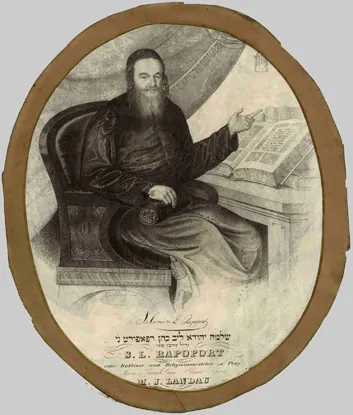
Solomon Judah Loeb Rapoport ("Shir")
1790 – 1867
Galician-born scholar and Chief Rabbi of Prague, and one of the founders of the Wissenschaft des Judentums — the historical-critical study of Jewish texts. His biographical essays on medieval rabbis remain standard reading. Wikipedia ↗
-
Moritz Rappaport
1808 – 1880
Physician and poet of Lviv, best remembered for his epic poem Moses (1842) — a rare figure who practised medicine and letters in equal measure, echoing the family's oldest traditions.
-
Arnold Rapoport von Porada
b. 1840
Deputy of the Austrian Reichsrat, ennobled in 1890 with the title von Porada.
-
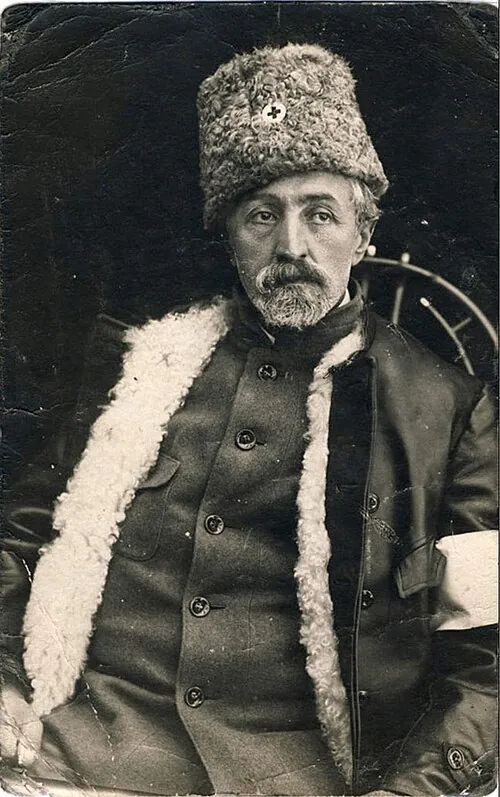
Shloyme Zanvl Rapoport (S. An-sky)
1863 – 1920
Russian Jewish writer and ethnographer, author of the play The Dybbuk. Wikipedia ↗
-
Charles Rappoport
1865 – 1941
Russian-born French socialist politician and intellectual. Wikipedia ↗
-
Anatol Rapoport
1911 – 2007
Russian-born American mathematical psychologist and game theorist, celebrated for his "tit-for-tat" strategy in iterated prisoner's-dilemma tournaments and his work on systems theory and conflict resolution. Wikipedia ↗
-
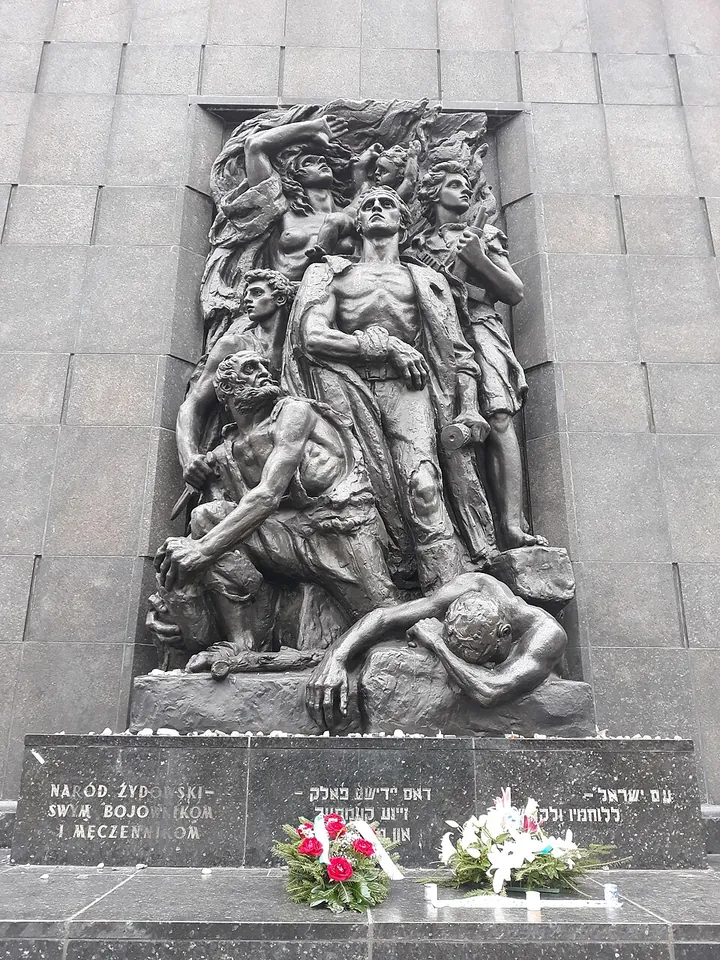
Nathan Rapoport
1911 – 1987
Polish-born Jewish sculptor, best known for the monumental Warsaw Ghetto Heroes Monument (1948), Scroll of Fire in the Judean hills, and the Liberation memorial in Liberty State Park, New Jersey. Wikipedia ↗
Many other bearers of the name — physicians, communal leaders, soldiers, scholars — appear in records across Galicia, Bohemia, Hungary, England, and the United States. Suggestions for additions are welcome.
.gif)


Timeline§
A compressed view of five centuries of the family's history, from the Rhine to the modern diaspora.
- c. 1450Rhineland (Germany)Meshullam Kusi Rapa ha-Kohen recorded
- 1462Mainz (Germany)Jews expelled; family disperses south
- 1467–75Venice & Mestre (Italy)Hayyim Rappe and Moses Rap in Italy
- 1540Porto Mantovano (Italy)Isaac Porto ha-Kohen builds the synagogue
- 1560Poznań (Poland)Akiva Rapoport born in Wielkopolska
- 1581Metele (Lithuania)Schleima-Lipa Rapoport recorded in Lazdijai
- 1594Verona (Italy)Minhah Belulah printed; crest fixed
- 1643Metele (Lithuania)Akiva Rapoport dies in his adopted home
- 1700–71Lvov (Ukraine)Hayyim Rapoport, Chief Rabbi of Lvov
- 1790–1867Prague (Czechia)Solomon Judah Rapoport, “Shir”
- 1864Warsaw (Poland)Marks Raperport born
- 1925Whitechapel, London (England)Marks Raperport dies; English spelling fixed
A Map of the Journey§
A schematic map of the principal places associated with the family, plotted to their approximate geographic positions. The dashed line traces the documented journey of one specific Raperport branch — from medieval Mainz (Germany), south into Renaissance Italy, north-east to Poznań (Poland), east into the Lithuanian villages of the Lazdijai district, and finally west via Warsaw to the East End of London.
The journey of this line
- 1Mainz (Germany) Rhineland, c. 1450 – 1462
- 2Porto Mantovano (Italy) near Mantua, 16th century
- 3Poznań (Poland) Akiva Rapoport, b. 1560
- 4Lazdijai (Lithuania) Metele, Vishay and Kukliai, from 1581
- 5Warsaw (Poland) Marks Raperport, b. 1864
- 6London (England) Whitechapel, from c. 1898
Wider family branches
- APrague (Czechia)
- BKraków (Poland)
- CLvov (Ukraine) Galicia
Glossary§
A few terms that recur throughout the page, briefly explained.
- Ashkenazi
- The Jewish communities (and the cultural and liturgical tradition) of medieval and modern central and eastern Europe — historically distinct from Sephardi (Iberian) and Mizrahi (Middle Eastern) traditions, though intermarried with both.
- Kohen (pl. Kohanim)
- A member of the Jewish priestly clan, descended by patrilineal line from Aaron, brother of Moses. Kohanim retain certain ceremonial functions in the synagogue today, including the priestly blessing performed with hands raised in a distinctive gesture.
- Rapa / Rappe
- Middle High German Rappe, "raven" — the most widely accepted source of the first element of the name, and the bird that appears on the family escutcheon.
- Porto
- The small Italian town in the province of Mantua, today usually called Porto Mantovano, from which the second element of the surname is taken. Not to be confused with Oporto in Portugal.
- Rapa-Porto
- The original hyphenated form of the name, combining the German-Rhenish Rapa with the Italian Porto. The ancestor of every modern Rappaport / Rapoport / Raperport spelling.
- Minhah Belulah
- Literally "a meal-offering well mingled" (Numbers 28:13). A Pentateuch commentary by Abraham Menahem ben Jacob ha-Kohen Rapa of Porto, printed at Verona in 1594, and the source of the family escutcheon reproduced on this page.
- Shoah
- The Hebrew name for the Holocaust — the systematic murder of approximately six million European Jews by Nazi Germany and its collaborators between 1933 and 1945. Many Rappaport and Raperport branches were destroyed.
- Wissenschaft des Judentums
- "The science of Judaism" — the 19th-century scholarly movement, centred in central Europe, that applied modern historical and philological methods to Jewish texts and history. Solomon Judah Rapoport was one of its founders.
- Escutcheon
- The shield on which a coat of arms is displayed. The Rapa-Porto escutcheon shows a raven, two priestly hands raised in blessing, and a Hebrew inscription.
Notes & Further Reading§
The historical claims on this page draw on the standard reference works for the Rapa-Porto / Rappaport family and for medieval and early-modern Ashkenazi history more broadly. The following are useful starting points for anyone wishing to dig deeper or verify particular details.
- The Jewish Encyclopedia (Funk & Wagnalls, 1901–1906), entries "Rapoport" and "Rapa (Porto), Menahem Abraham" — still-useful summaries of the rabbinic family and its principal branches, recording the family's spread to some eighty cities of Europe and Asia within four and a half centuries.
- The Wikipedia article "Rappaport family" and the surname survey at "Rappaport (surname)", with onward references.
- The Rapoport DNA Project at FamilyTreeDNA — ongoing Y-DNA testing of bearers of all spellings; results to date find Cohen Modal Haplotype signatures (haplogroup J1) in several tested lines, consistent with the family's Kohanite tradition, alongside confirmation that a number of distinct lineages share the surname.
- The Chabad.org essay "What Does the Jewish Last Name Rapoport Mean?" — an accessible account of the name's origins and the raven tradition.
- Encyclopaedia Judaica (2nd ed., Macmillan / Keter, 2007), entries "Rapoport", "Rapa-Porto", "Mantua", and "Porto Mantovano".
- Eliakim Carmoly, Ha-Orevim ve-Yonah ("The Ravens and the Doves"), Rödelheim, 1861 — a 19th-century genealogical treatment of the family by a sometimes-unreliable but influential compiler.
- Abraham Menahem ben Jacob ha-Kohen Rapa of Porto, Minhah Belulah, Verona, 1594 — the printed work whose title-page escutcheon is the source of the crest reproduced here. Digital copies are held by the National Library of Israel and the Bibliothèque nationale de France.
- Cecil Roth, The History of the Jews of Italy, Jewish Publication Society, 1946 — for the Italian setting of the family's emergence.
- Meir Wunder, Meʾorei Galitsiyah: Entsiklopedyah le-Ḥakhmei Galitsiyah, 6 vols., Jerusalem, 1978–2005 — the standard biographical encyclopaedia of Galician rabbis, including extensive Rapoport entries.
- JewishGen Family Finder and the Rapaport DNA Project at FamilyTreeDNA — for living descendants attempting to link a particular line to the wider family.
- For the heraldic tradition, Daniel M. Friedenberg, Jewish Medals from the Renaissance to the Fall of Napoleon, New York, 1970, and Alfred Rubens, A Jewish Iconography, London, 1954.
Corrections and additions are warmly welcomed.